The Story of Ode
Gravity Road's co-founder, Mark Eaves, on Ode, the AI poetry companion built with Microsoft AI and The Poetry Pharmacy creator William Sieghart, and the two years he spent waiting for voice technology to catch up with the idea.
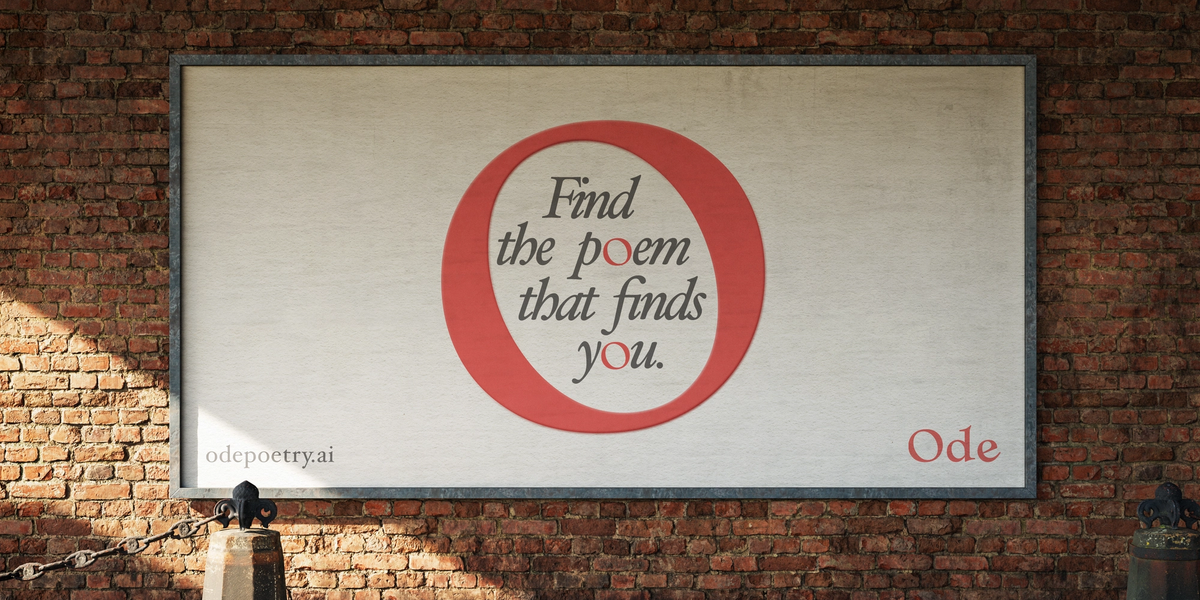
Gravity Road's co-founder, Mark Eaves, on Ode, the AI poetry companion built with Microsoft AI and The Poetry Pharmacy creator William Sieghart, and the two years he spent waiting for voice technology to catch up with the idea.
The idea for Ode is two years old. That makes me sound patient and far-sighted. In truth, I mostly poked at voice demos, muttering “not yet”. We just had to wait for the tech to catch up.
The idea came from William Sieghart's book, The Poetry Pharmacy, comprising verse prescriptions; poems grouped uniquely by how you're feeling. That it became, and remains, Amazon's bestselling anthology just after Covid is telling. Such was the demand, he created a charity and began IRL one-to-one sessions at music and literary festivals: he would ask how you were feeling, then choose the poem to meet that moment. But William can be in only one room at a time. I wanted that moment available in everyone's lives.
We have never been so connected, yet so lonely. Loneliness affects one in six people worldwide (according to the World Health Organisation), and more than a quarter of British adults (Office for National Statistics). Poetry was invented for this. It takes the feeling you can't name and shows you a stranger felt it too, and found the words. And the audience is turning up: poetry is the fastest-growing corner of literature among young audiences (#PoetryTok), yet more than half of them never touch it. Not because they don't feel. Because nobody convinced them it was for them.
So two years ago, I built a prototype using a custom GPT. (Remember custom GPTs?) The matching worked quite well. But the voice sank it: imagine a satnav recommending you Wendy Cope. Voice tech often gets 90% of the way; the whole game is in the final 10% – the nuances, the pauses, the breaths, the subtle human imperfections of delivery. Poetry is where people go to feel less alone, not to be patronised by robot empathy. The prototype went in the bottom drawer.
What got it out again was Microsoft AI's new MAI voice stack and the passion of its Superintelligence team. We rebuilt William's manner in his own consented voice: the warmth, the patience, the way he leaves room for you to actually answer. Then we played it to him. "The intonation, the pauses," he said. "I just thought, wow, that's quite nice." If he'd winced, we'd have gone home.
Read the rest of the article here